
3 Warren Buffett tips on how to invest in banks

As one of the greatest investors to have ever lived, here’s Warren Buffett’s advice on how to invest in bank stocks.

The content of this article was relevant at the time of publishing. Circumstances change continuously and caution should therefore be exercised when relying upon any content contained within this article.

Warren Buffett at a Berkshire Hathaway AGM

Image source: The Motley Fool

You’re reading a free article with opinions that may differ from The Motley Fool’s Premium Investing Services. Become a Motley Fool member today to get instant access to our top analyst recommendations, in-depth research, investing resources, and more. Learn More.

Investing in banks can expose investors to huge amounts of risks. The recent collapse of Silicon Valley Bank (SVB) serves as a stark reminder of how fragile these institutions can be. So, here are three of Warren Buffett’s best tips on how to pick the best bank stocks.

1. Demand a margin of safety

Banking is inherently a risky business. High street banks tend to loan out sizeable chunks of customer deposits and earn profits from the interest they get from those loans. This means that they’re almost always in a deficit.

Thus, if customers begin to withdraw their funds en masse, banks may find it difficult to find liquidity, leading to what many refer to as a liquidity crisis. This was what led to the failures of SVB and several of its regional competitors.

Nonetheless, these failures were partially a result of irresponsible capital allocation. As such, Warren Buffett’s advice on finding banks with a margin of safety is extremely important. The Oracle of Omaha believes that buying a stock is like buying a business, and doing due diligence is essential.

Therefore, it’s crucial to ensure that a company has ample liquidity and a robust set of financials to withstand an economic downturn or liquidity crisis. These can be evaluated through ratios such as CET1 (comparing a bank’s capital against its assets), liquidity coverage, and countercyclical ratios.

2. Look for economic moats

Most of Warren Buffett’s investments are in conglomerates with competitive advantages over their competitors. That’s because companies that can successfully fend off competitors have better odds of growing their intrinsic value over time. This same precedent can be applied to banks.

The fall of several regional banks in the US has resulted in a flight to quality. Consequently, the likes of JP Morgan and Bank of America have received tens of billions in customer deposits since SVB’s turmoil. This is what Warren Buffett would call en economic moat.

It’s for those reasons that UK banks stand out as the most attractive to me — their strength and reliability. This is because their lower-risk deposit base gives them a much bigger buffer to protect themselves from a liquidity crisis.
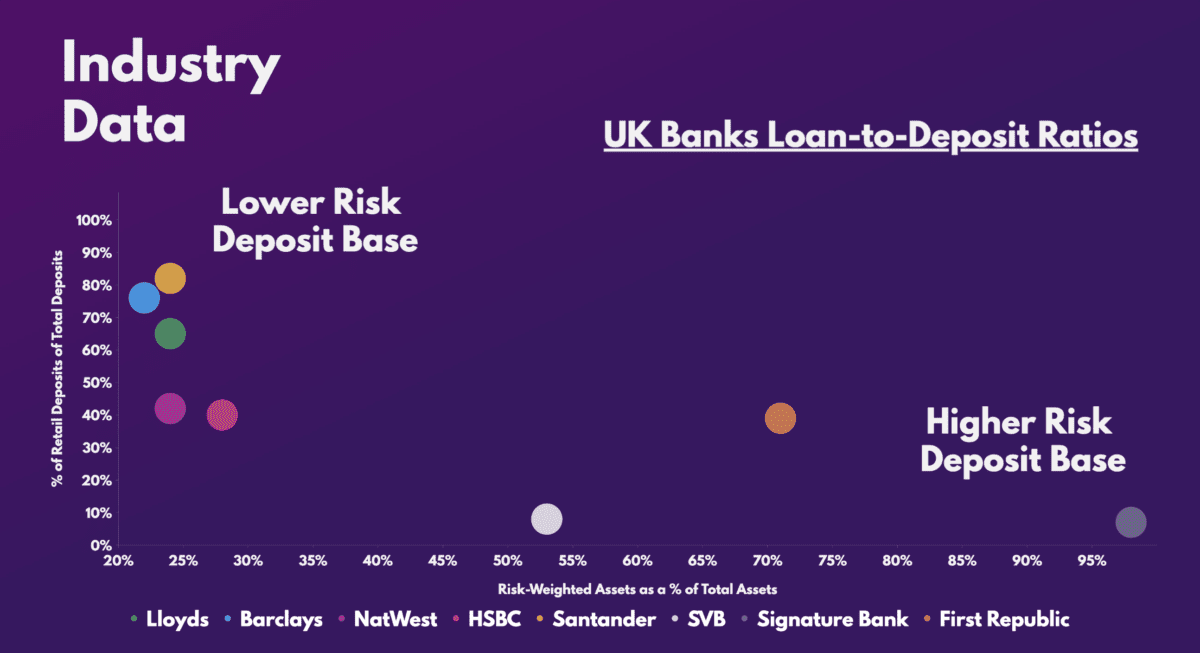
Warren Buffett - UK Banks Loan-to-Deposit Ratios.
Data sources: Lloyds, Barclays, NatWest, HSBC, Santander UK, SVB, Signature Bank, First Republic

This stems from the fact that the amount of risk-weighted assets they hold are much lower than their US counterparts. Moreover, the number of retail customers they have is significantly higher. Hence, the likelihood of a bank run is lower as the majority of their funds are insured by a regulatory body.

3. Focus on the long term

Another Warren Buffett tip is to focus on the returns a bank can make over the long term. In the context of bank stocks, they should generate high interest margins (the difference between income generated from interest-bearing assets and liabilities) and good returns on tangible equity (ROTE).

Nevertheless, there’s a fine line between striving for large returns and potentially plunging a business into the ground. Getting too greedy can result in bankers taking unnecessary risks, while being too conservative may result in low profits.

Thankfully though, UK banks sit between the two, which is why I’m invested in Lloyds. And given their cheap valuation multiples with a strong outlook for net interest income and ROTE for the years ahead, I may even start a position in Barclays.

MetricsLloydsBarclaysIndustry average
Price-to-book (P/B) ratio0.70.30.7
Price-to-earnings (P/E) ratio6.24.58.9
Forward price-to-earnings (FP/E) ratio6.64.75.7
Data source: Google Finance

SVB Financial provides credit and banking services to The Motley Fool. Bank of America is an advertising partner of The Ascent, a Motley Fool company. JPMorgan Chase is an advertising partner of The Ascent, a Motley Fool company. John Choong has positions in Lloyds Banking Group Plc. The Motley Fool UK has recommended Barclays Plc and Lloyds Banking Group Plc. Views expressed on the companies mentioned in this article are those of the writer and therefore may differ from the official recommendations we make in our subscription services such as Share Advisor, Hidden Winners and Pro. Here at The Motley Fool we believe that considering a diverse range of insights makes us better investors.

More on Value Shares

Investing Articles

Could the Barclays share price be the FTSE 100’s big winner in 2026?

With OpenAI and SpaceX considering listing on the stock market, could investment banking revenues push the Barclays share price higher…

Read more »

Snowing on Jubilee Gardens in London at dusk
Value Shares

Is it time to consider buying this FTSE 250 Christmas turkey?

With its share price falling by more than half since December 2024, James Beard considers the prospects for the worst-performing…

Read more »

Group of young friends toasting each other with beers in a pub
Investing Articles

FTSE 100 shares: has a once-a-decade chance to build wealth ended?

The FTSE 100 index has had a strong 2025. But that doesn't mean there might not still be some bargain…

Read more »

Person holding magnifying glass over important document, reading the small print
Investing Articles

Is this FTSE 250 retailer set for a dramatic recovery in 2026?

FTSE 250 retailer WH Smith is moving on from the accounting issues that have weighed on it in 2025. But…

Read more »

UK financial background: share prices and stock graph overlaid on an image of the Union Jack
Investing Articles

Down 38% with a 4% yield and P/E below 12! Are Greggs shares now a generational bargain?

Greggs’ shares have cooled over the last year, but the FTSE 250 stock got a fresh burst of energy after…

Read more »

Man putting his card into an ATM machine while his son sits in a stroller beside him.
Investing Articles

As the Lloyds share price heads towards a pound, is it still a bargain?

The Lloyds share price has been on a roll over the past few years. Our writer gives his take on…

Read more »

Hand of person putting wood cube block with word VALUE on wooden table
Investing Articles

UK shares look cheap — but the market might be about to take notice

UK shares have traded at a persistent discount to their US counterparts. This can create huge opportunities, but investors need…

Read more »

Middle-aged white man wearing glasses, staring into space over the top of his laptop in a coffee shop
Investing Articles

£10,000 invested in Diageo shares 4 years ago is now worth…

Harvey Jones has taken an absolute beating from his investment in Diageo shares but is still wrestling with the temptation…

Read more »