
We have some exciting news to share! The Motley Fool UK has now become an independent, UK-owned company, led by our long-serving UK management team — Mark Rogers, Chris Nials and Heather Adlington. In practical terms, it’s the same team you know, now fully focused on serving our UK readers and members.

Just as importantly, our approach remains unchanged: long-term, jargon-free, and on your side. We’ll be introducing a new name and brand over the coming weeks — we're very excited to share it with you and embark on this new chapter together!

Are Unilever shares a good inflation hedge?

Inflation continues to erode consumer spending. However, could Unilever shares be a good inflation hedge given the nature of its products?

| More on:

The content of this article was relevant at the time of publishing. Circumstances change continuously and caution should therefore be exercised when relying upon any content contained within this article.

You’re reading a free article with opinions that may differ from The Motley Fool’s Premium Investing Services. Become a Motley Fool member today to get instant access to our top analyst recommendations, in-depth research, investing resources, and more. Learn More.

Middle-aged black male working at home desk

Image source: Getty Images

Inflation has been running rampant this year. As a result, share prices of non-energy-related companies have suffered due to waning consumer demand. Nonetheless, there are a couple of shares that have been able to pull their weight, with Unilever (LSE: ULVR) being one of them. As such, could Unilever shares be a good inflation hedge for my portfolio?

Good Degree of progression

Looking at Unilever’s stock performance year-to-date against the FTSE 100, I can see it’s done relatively well. Its share price is largely unmoved while the UK index has declined by about 5%. Additionally, Unilever has a 3% dividend yield that has helped investors further hedge against the impact of inflation on their investments.

What’s behind the robust Unilever share price performance then? It can be attributed to its strong brand presence paired with demand inelasticity for most of its products. These brands tend to be staples such as Dove, Knorr, Cif, and more. Hence, the company can maintain its already excellent profit margins by passing on higher costs to consumers. This was evident in the half-year results that saw numbers coming in above consensus.

MetricsAmount (H1 2021)Analysts Earnings Estimates (H1 2022)Amount (H1 2022)
Revenue€25.8bn€29.0bn€29.6bn
Underlying Earnings per Share (EPS)€1.33€1.27€1.34
Source: Unilever Investor Relations

A new Dawn

That said, despite the strong performance, investing in Unilever shares involves a couple of risks. For one, CEO Alan Jope is planning to leave at the end of 2023. This is partly due to pressure from unhappy investors after Unilever bungled its attempt to buy GSK‘s consumer healthcare business. Renowned fund manager Terry Smith even accused it of losing its focus on profit. Therefore, the long-term outlook for the company remains uncertain as competition for a new CEO is hot, with competitor Reckitt Benckiser also searching.

Second, Unilever’s financials aren’t in the best state. Its balance sheet leaves plenty to be desired as it currently has a debt-to-equity ratio of 141.6%. Its debt has also been steadily increasing since 2018 due to dividend payouts. In my opinion, this isn’t good allocation of capital as I’d rather have Unilever pay off debt and shore up cash levels than give out dividends and incur higher debt.
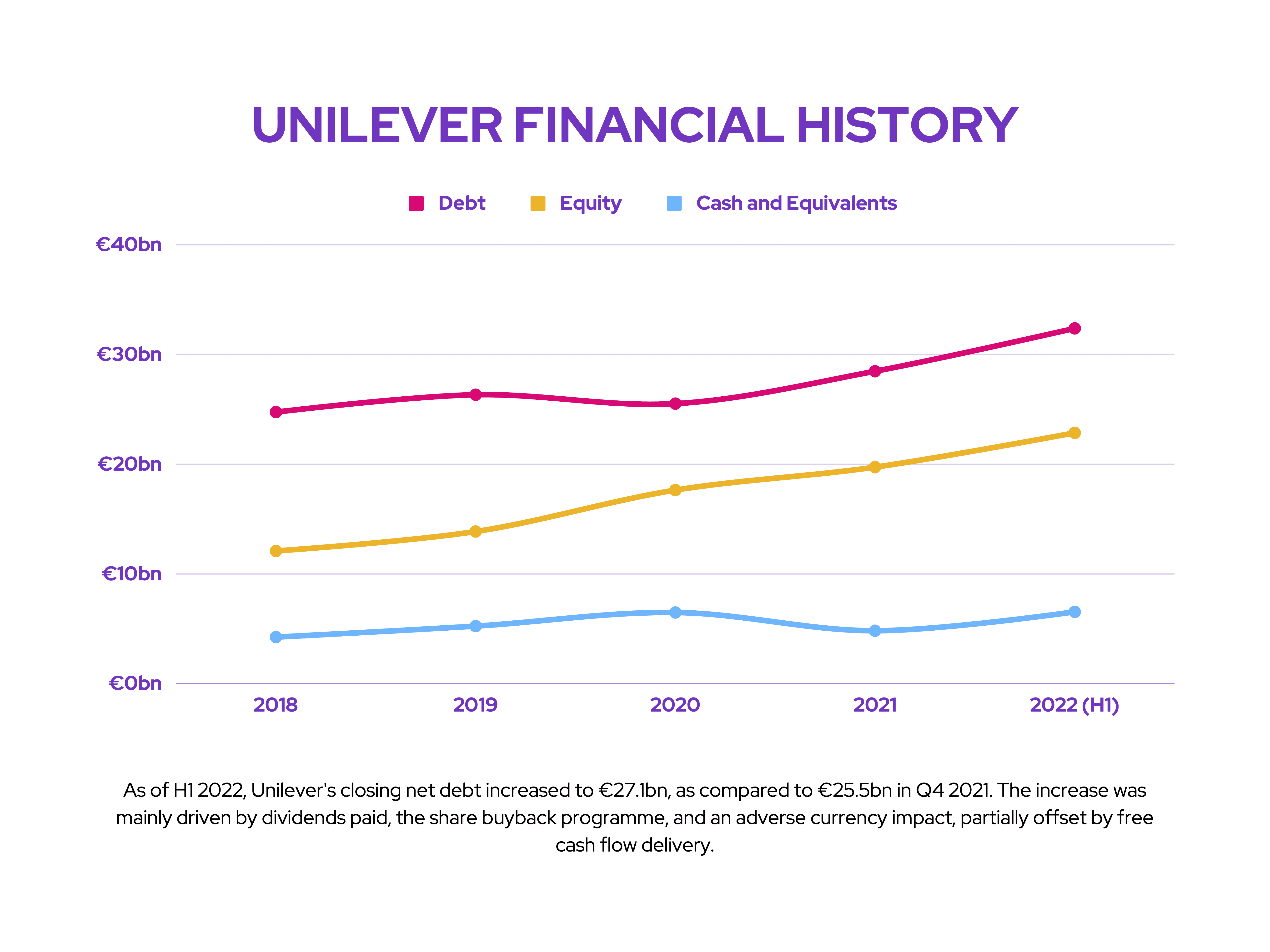
Unilever: Unilever Financial History
Source: Unilever Investor Relations

Positive Signal?

So, what do I make of Unilever shares? Well, it’s worth noting that the stock recently received favourable coverage from Goldman Sachs. The investment bank maintains its neutral rating on the stock, but stated that pricing momentum should support the group’s growth outlook.

Consequently, analysts at Goldman expect Unilever to report 8.5% sales growth in Q3, which is higher than the average consensus of 7.9%. Overall, this would translate into full-year growth of 7.8%, compared to the company’s guidance of 6.5%. And with India set to overtake the US as the producer’s largest business region, the emerging market could help boost sales by quite some margin in the medium term.

Nevertheless, I’m still not convinced enough to purchase Unilever shares. While the short-term prospects look decent for the company, I’m less certain about its long-term vision given the state of its balance sheet and departing CEO. I’ve no doubt that the blue-chip stock will do just fine, but I reckon I can boost my wealth by buying shares in companies that have better growth potential and more robust financials.


John Choong has no position in any of the shares mentioned. The Motley Fool UK has recommended GSK plc, Reckitt plc, and Unilever. Views expressed on the companies mentioned in this article are those of the writer and therefore may differ from the official recommendations we make in our subscription services such as Share Advisor, Hidden Winners and Pro. Here at The Motley Fool we believe that considering a diverse range of insights makes us better investors.

More on Investing Articles

One English pound placed on a graph to represent an economic down turn
Investing Articles

Are we approaching a full-blown stock market crash?

Despite the war in Iran, we've avoided a stock market crash so far. Harvey Jones is gearing up to buy…

Read more »

Young mixed-race couple sat on the beach looking out over the sea
Investing Articles

This S&P 500 giant is building a global super app

If this household S&P 500 company achieves its ultimate aim, it could become a hell of a lot bigger in…

Read more »

Friends at the bay near the village of Diabaig on the side of Loch Torridon in Wester Ross, Scotland. They are taking a break from their bike ride to relax and chat. They are laughing together.
Investing Articles

How to target a £1m Stocks and Shares ISA by investing £511 a month

Fancy becoming a Stocks and Shares ISA millionaire? Harvey Jones thinks this long-term investment strategy could help you get there…

Read more »

A senior group of friends enjoying rowing on the River Derwent
Investing Articles

How much do investors need in an ISA to target a £31,353 yearly passive income

Harvey Jones shows how building a portfolio of FTSE 100 shares can generate enough passive income to enjoy a truly…

Read more »

Man smiling and working on laptop
Investing Articles

These 3 ‘secret’ dividend shares could be top stocks to buy in May!

Forget FTSE 100 dividend shares. And look past the FTSE 250 for passive income. Here are three lesser-known dividend stocks…

Read more »

Friends and sisters exploring the outdoors together in Cornwall. They are standing with their arms around each other at the coast.
Investing For Beginners

How much is needed in an ISA for a £35,828 passive income from FTSE shares?

Royston Wild reveals how a Stocks and Shares ISA invested in FTSE 100 shares could deliver a huge passive income…

Read more »

Hydrogen testing at DLR Cologne
Investing Articles

17% below their 52-week high, is now an opportunity to consider Rolls-Royce shares?

Rolls-Royce Holdings shares have fallen significantly since March. James Beard asks whether now could be a good time for latecomers…

Read more »

Thoughtful man using his phone while riding on a train and looking through the window
Investing Articles

Just Released: Our Top Defence Stock For ISAs In May 2026 [PREMIUM PICKS]

Fire stock picks will tend to be more adventurous and are designed for investors who can stomach a bit more…

Read more »