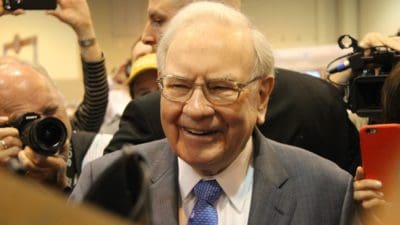
When it comes to generating wealth from the stock market, Warren Buffett has an astonishing track record. Had you invested $1,000 with the investment guru when he took over Berkshire Hathaway back in 1964, that money would now be worth around $35m.
What’s really interesting about Buffett though, is that his investment strategy isn’t that complicated. Anyone can invest like he does.
With that in mind, here’s a look at how I’d use his stock-picking system to find the best FTSE 100 stocks to buy for my portfolio.
Buffett likes a competitive advantage
When Buffett is analysing companies, one of the first things he looks for is a competitive advantage, or ‘economic moat’ as he likes to say. This is essentially an edge over competitors.
“The key to investing is not assessing how much an industry is going to affect society, or how much it will grow, but rather determining the competitive advantage of any given company and, above all, the durability of that advantage,” he’s said.
The reason a durable competitive advantage is crucial is that it protects a company’s profits. If a business doesn’t have one, competitors can enter the market and offer the same products or services at lower prices. Profits then get eroded.
Within the FTSE 100, I see a number of companies with robust competitive advantages. Alcoholic beverages company Diageo is one. It has some great brands that consumers love such as Johnnie Walker and Tanqueray.
London Stock Exchange is another. It basically operates the plumbing of the UK’s financial system. A rival can’t easily replicate its business model.
Rightmove is a third. It has an incredibly strong brand and a 90% share of the property website market.
Long-term growth potential
Buffett also likes companies that have the potential to grow their earnings over the long run.
“Your goal as an investor should simply be to purchase, at a rational price, a part interest in an easily-understandable business whose earnings are virtually certain to be materially higher five, ten and twenty years from now,” he says.
Now finding companies in the FTSE 100 that are ‘virtually certain’ to have higher earnings in the future is not easy. A lot of companies in the index are facing challenges today.
I reckon Diageo is probably a good shout though. Between now and 2030, the world’s middle class is set to grow substantially, meaning there will be millions of extra consumers that can afford its premium alcoholic beverages.
Profitability: the key to big long-term returns
Profitability is another major area of focus for the investment legend. Here, he zooms in on a company’s return on equity (ROE) and return on capital employed (ROCE). He likes companies that are highly profitable because these companies tend to generate big returns for shareholders over the long run as they reinvest their profits.
Buffett’s business partner, Charlie Munger, sums this up well: “Over the long term, it’s hard for a stock to earn a much better return than the business which underlies it earns. If the business earns six percent on capital over forty years and you hold it for that forty years, you’re not going to make much different than a six percent return – even if you originally buy it at a huge discount. Conversely, if a business earns eighteen percent on capital over twenty or thirty years, even if you pay an expensive looking price, you’ll end up with one hell of a result.”
So what FTSE 100 companies are highly profitable? Well, Rightmove is one. Over the last five years, it has generated an average ROCE of 517%, which is outstanding. Auto Trader is another. Its five-year average ROCE is about 55%.
Unilever, Next, RELX, and Hargreaves Lansdown are some other companies worth mentioning here. They’ve all averaged a ROCE in excess of 20% over the last five years.
Reducing risk
As for risk, one way Buffett mitigates this is by paying attention to debt on the balance sheet.
“I do not like debt and do not like to invest in companies that have too much debt, particularly long-term debt. With long-term debt, increases in interest rates can drastically affect company profits and make future cash flows less predictable,” he has said.
This quote is particularly relevant right now. With interest rates rising, highly-leveraged companies could face challenges in the years ahead.
Some companies in the FTSE 100 that have high levels of debt include BT, National Grid and Imperial Brands. So I’d avoid these these businesses. Some companies that have low levels of debt are Rightmove, InterContinental Hotels, and Hargreaves Lansdown.
Buffett doesn’t always go for cheap stocks
Now when it comes to valuation, Buffett has an interesting approach. You see, he does like value. However, he also believes that in investing, like many things in life, you get what you pay for. So he’d rather pay a higher valuation for a really top company, than invest in an average company at a bargain price.
“It’s far better to buy a wonderful company at a fair price, than a fair company at a wonderful price,” he says.
This makes sense, in my view. Generally speaking, the market is pretty efficient at pricing stocks correctly and cheap stocks are often cheap for a reason.
Some of the FTSE 100 stocks I have mentioned so far do have higher valuations. Diageo, for example, currently has a forward-looking price-to-earnings (P/E) ratio of about 25. Rightmove has a P/E ratio of about 27.
These higher valuations add some risk. However, I think Buffett might be prepared to pay them. After all, he owns some stocks with higher valuations than this, such as Amazon (63) and Mastercard (35).
Investing like Buffett
So that’s how I’d apply Buffett’s system to the FTSE 100 to find top stocks to buy. I’d look for high-quality companies with strong competitive advantages, plenty of growth potential, high returns on capital, and strong balance sheets.
But there is one more thing I should mention. And that is that a lot of Buffett’s success is down to his long-term approach.
“Successful investing takes time, discipline, and patience,” he says.
His ‘business owner’ attitude has also played a key role in his success.
“I view the stocks that Berkshire owns as interests in businesses, not as ticker symbols to be bought or sold based on their ‘chart’ patterns, the ‘target’ prices of analysts or the opinions of media pundits,” he says.
So if I was investing in Buffett-style FTSE 100 stocks today, I’d follow him and invest for the long run.