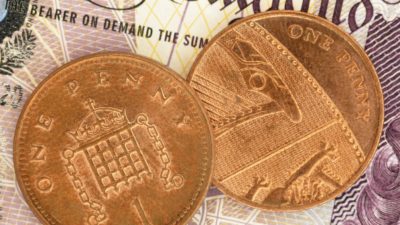
You have to deal with currency swings in all market conditions, so I wouldn’t lose sleep over it — not even now that the British pound trades at multi-year highs against the euro and has rallied against the US dollar and other currencies.
True, a strong pound could harm the domestic economy because it could reduce exports, but it could also signal the possibility of rising interest rates, higher investment and stronger consumption rates in the UK. The latter is my preferred scenario.
In a low-rate environment that is likely to persist, strength in the domestic currency is more likely to boost the FTSE 100 than to sink it, in my view, while strengthening the UK’s position as a safe haven in the West. It could well be a win-win for currency and equity investors.
Trends
It’s never been easy to determine whether the psychological benefits of a strong domestic currency outweigh the obvious downside — a loss of competitiveness, lower tax receipts and so forth — that such a situation may bring.
Inter-market analysis, according to which different asset classes tend to manifest similar patterns and key relationships over time, provides a helping hand in the determination of possible trends for equities, bonds and commodities — but currency movements are seldom easy to predict.
One year ago, reports suggested that the UK’s blue-chip index was sitting “on a ticking timebomb of revisions to forecast earnings after sterling hit a six-year high.”
Earnings have indeed gone down at a few UK companies with worldwide currency exposure, but the FTSE 100 is flat over the period, while other elements have contributed to its poor performance, I’d argue.
Encouraging Signs
So, the UK is doing better than others — and that’s reflected in a strong sterling.
As the Guardian noted last month, a jump in exports had “helped Britain’s trade gap narrow to its smallest for a year in April, raising hopes that overall economic growth has rebounded from its slump at the start of 2015.“
At less then £9bn, the trade deficit’s figures caught bearish economists by surprise — the country recorded the lowest deficit since early 2014.
Mark Carney, the Governor of the Bank of England, hinted at a slow rise in rates between 2015 and 2016, but hawkish monetary policies are not an option for the European Central Bank, while the US has been slower to act than I expected it to be — and one key problem for the US is that it can hardly afford a much stronger domestic currency.
Consider recent trends.
Against the euro, the British pound has risen:
- 11.3% since the turn of the year (FTSE +3.8%);
- 13.4% over the last 12 months (FTSE +0.7%);
- 23% over the last two years (FTSE +2.5%).
The FTSE could benefit from troubles elsewhere, even more so now than in the past.
If European countries do not manage to find some kind of stability, I wouldn’t be surprised if the £/€ surpassed its previous pre-crisis highs, heading from its current 1.4/2 towards 1.8/2 by 2020.
Against the US dollar, the British Pound has risen:
- 6.6% since its one-year trough in mid-April;
- o.2% since the turn of the year;
- 2.5% since July 2013.
Meaningful fluctuations in global currency markets may determine short-term volatility for the stocks of companies with worldwide exposure but, in my experience, long-term value is the inevitable outcome when companies present a balanced mix of strong fundamentals and accurate projections as well as friendly capital allocation strategies and attractive trading metrics.